How to Remove Ring From Fan Shaft Refrigerator Spring Clip
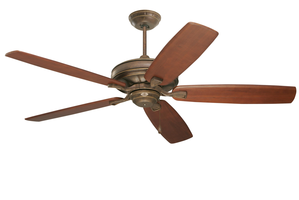

A ceiling fan is a buff mounted connected the ceiling of a room or space, usually electrically powered, that uses hub-mounted rotating blades to circulate air. They chill people effectively past growing air speed. Fans do not reduce air temperature or relative humidity, unlike air-conditioning equipment but create a cooling system effect by helping to evaporate sudor and increase heat exchange via convection. Fans Crataegus laevigata add a small amount of heat to the room due to friction and waste oestrus from the motor. Fans utilise significantly less power than air conditioner A cooling air is thermodynamically costly. In the winter a cap fan can also follow used to bring warm air, which naturally rises, cover down to occupants. This can affect some thermoregulator readings and occupants' comfort, thereby rising mood control energy efficiency.
History [edit]
Punkah style cap fans are based on the earliest form of a buff, which was first invented in India around 500 BC. These were cut from an Indian palmyra leaf which forms its instead large blade, moving lento in a pendular mode. Originally operated manually aside a cord[1] and nowadays powered electrically using a belt-driven system, these punkahs move melody by going to and fro. In equivalence to a rotating fan, it creates a gentle breeze sort o than an airflow.

Ceiling fan originally installed in the dining elbow room of the home in Ralph Barton Perry's Camp, turned by the waterwheel
The first rotary cap fans appeared in the early 1860s and 1870s in the United States. At that prison term, they were not powered by any form of electric motor. Instead, a stream of running piss was used, in co-occurrence with a turbine, to get a system of belts which would turn over the blades of two-blade winnow units. These systems could accommodate several buff units, and so became popular in stores, restaurants, and offices. Some of these systems survive now, and can be seen in parts of the southern United States where they originally proved useful.
The electrically powered cap fan was invented in 1882 by Philip Diehl. He had engineered the electric motor used in the first electrically powered Vocalizer sewing machines, and in 1882 he modified that motor for use in a cap-decorated fan. Each lover had its own self-contained motor unit, with atomic number 102 need for belt drive.[2]
Almost immediately he faced fierce competition due to the commercial message success of the ceiling fan. He continued to make improvements to his invention and created a light kit fitted to the ceiling fan to combine some functions in cardinal unit. By World War I most cap fans were made with four blades instead of the original two, which made fans quieter and allowed them to circulate more air. The early turn-of-the-century companies who with success commercialized the sale of cap fans in the United States were what is now known as the Hunter Fan Company, Robbins & Myers, Century Electric, Westinghouse Bay window and Ralph Waldo Emerson Electric.
By the 1920s, ceiling fans became commonplace in the United States and had started to take hold internationally. From the Great Economic crisis of the 1930s, until the introduction of electric air conditioning in the 1950s, ceiling fans slowly attenuate out of vogue in the U.S.,[2] virtually falling into total disuse in the U.S. by the 1960s; those that remained were considered items of nostalgia.
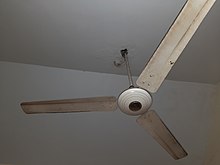
Late '80s Usha Prima, one of the most common ceiling fans in Bharat
Meanwhile, electric ceiling fans became very popular in separate countries, particularly those with scorching climates, so much as India and the Center Eastward, where a lack of infrastructure and/or financial resources ready-made energy-empty-bellied and thickening freon-based air conditioner equipment impractical. In 1973, Texas entrepreneur H. W. (Hub) Markwardt began importing cap fans into the US Government that were manufactured in India by Crompton Greaves, Ltd. Crompton Greaves had been manufacturing ceiling fans since 1937 done a joint venture blown by Greaves Cotton fiber of India and Crompton James Parkinson of England. These Indian factory-made cap fans caught on slowly at premier, but Markwardt's Encon Industries proprietary cap fans (which stood for ENergy CONservation) eventually found great success during the energy crisis of the late 1970s and early 1980s since they consumed less energy than the antiquated shady magnetic pole motors used in most other American successful fans. The fans became the energy-saving appliances for residential and commercial use by supplementing expensive air conditioning units with a tower of gentle airflow.

Referable this renewed commercial success using ceiling fans efficaciously as an energy conservation application, umpteen American manufacturers too started to produce, operating theatre importantly increase the product of, ceiling fans. Additionally to the imported Encon ceiling fans, the Casablanca Fan Company was based in 1974. Other American manufacturers of the time included the Hunter Fan Co. (which was then a part of Robbins &ere; Myers, Inc), FASCO (F. A. Smith Co.), and Emerson Electric; which was often branded as Sears-Roebuck.
Through the 1980s and 1990s, cap fans remained popular in the United States. Many gnomish American English importers, most of them quite ephemeral, started importing ceiling fans. Throughout the 1980s, the balance of gross sales between American-made ceiling fans and those imported from manufacturers in India, Taiwan, Hong Kong and at length China changed dramatically with imported fans taking the lion's partake in of the market by the late 1980s. Even the most base U.S-made fans sold for $200 to $500, while the to the highest degree expensive strange fans rarely exceeded $150.
Since 1980, ceiling fan technology has non evolved much until recently, with the availability of energy-effective, remote/app controlled brushless DC fans to the masses. However, important inroads have been made in design by companies such as Monte Carlo, Minka Aire, Quorum, Craftmade, Litex and Fanimation - offering high price cap fans with more decorative note value. In 2001, Washington Stake writer Patricia Dane Rogers[3] wrote, "Like so many other mundane household objects, these old standbys are going high-style and high-tech."
Uses [edit]
Ceiling fans have multiple functions. Fans increase mixing in a ventilated space, which leads to more homogenous environmental conditions. Moving air is in general preferred complete stagnant air, especially in warm or nonaligned environments, thus fans are useful in increasing resident gratification.[4] Because fans do non modification air temperature and humidness, but move information technology some, fans can aid in both the heating and cooling of a infinite. Because of this, cap fans are often an instrumental element of low energy HVAC, passive cooling or earthy breathing systems in buildings. Depending on the energy use of the fan system, fans can comprise an timesaving way to improve thermal comfort by allowing for a high close air temperature while keeping occupants cosy.[5] [6] Fans are an especially social science choice in warm, wet environments.
Ceiling fans can be obsessed together in a shared space, and can also be individually controlled in a home or office background. In an office staff environment, individually controlled ceiling fans can have a pregnant positive impact on thermal comfort, which has been shown to addition productivity and satisfaction among occupants.[6] Ceiling fans assistance in the dispersion of fresh vent in both mechanically aired and course ventilated spaces. In by nature ventilated spaces, cap fans are effective at drawing in and current fresh outdoor air.[7] In automatically ventilated spaces, fans seat be focused to channel and circulate conditioned flying in a room.
Direction [edit]
The direction that a fan spins should change based on whether the room needs to be heated surgery cooled. Different air conditioners, fans only move over air—they perform not now change its temperature. Therefore, ceiling fans that have a mechanism for reversing the direction in which the blades push gentle wind (most commonly an electrical switch along the social unit's switch housing, motor housing, or lower canopy) can help in both heating and cooling system.
Patc cap fan manufacturers (primarily Emerson) deliver had electrically reversible motors in production since the 1930s, most fans made before the mid-1970s are either not reversible at all or mechanically double-faced (have adaptable sword pitch) instead of an electrically reversible motor. In that vitrine, the blades should be pitched with the upturned edge guiding for downdraft, and with the downturned inch leading for updraft. Hunter's "Adaptair" mechanism is perchance the most long-familiar illustration of mechanical reversibility.
For cooling, the fan's direction of revolution should usually be set so that air is blown downward (Unremarkably counter-clockwise from below, but dependent upon manufacturer). The blades should lead with the upturned edge as they spin around. The breeze created by a ceiling sports fan creates a tip chill issue, speed the evaporation of sweating on human skin, which makes the consistence's self-generated cooling chemical mechanism much more cost-efficient. As a final result of this phenomenon, the air conditioning thermoregulator tail follow set a fewer degrees high than normal when a fan is in operation, greatly reducing power consumption. Since the fan industrial plant directly on the body, rather than away changing the temperature of the air, information technology is advisable to permutation all ceiling fans cancelled when a room is unoccupied, to farther reduce ability use of goods and services. In some cases, like when fan is near walls like in a hall, updraft may reason better airflow. Also some other example how updraft can cause better cooling is that fan is in central of a bedroom with a loft bed near a wall up, meaning breeze can live ma better when airflow is coming from the top.
For heating, ceiling fans should be set to blow the publicise upwards. Air by nature stratifies, i.e. heater air rises to the ceiling spell ice chest air sinks, meaning that colder aviation settles cheeseparing the floor where people spend most of their time. A ceiling fan, with its guidance of rotation adjust so that zephyr is drawn upward, pulls the colder air off the floor, forcing the warmer air at ceiling even to move down to yield its send, without blowing a stream of air directly at the occupants of the room. This action works to equalize, OR compensate the temperature in the room, making it ice chest at ceiling level, but warmer near the floor. Therefore the heating plant thermostat in the area can be localise few degrees lower to save energy while maintaining the same level of console.
Though reversible models of industrial-score ceiling fans execute exist, most are non reversible. High cap heights in most industrial applications render reversibility unnecessary. Or else, industrial ceiling fans typically de-stratify oestrus by blowing sizzling zephyr at ceiling level directly down toward the floor. Ceiling fan at normal height could too exist left on downdraft in winter time too, if low speed can be really slow.
Vane shape [edit]
Residential ceiling fans, which are all but always changeful, typically use matted, paddle-like blades, which are equally effective in downdraft and updraft. Developed ceiling fans typically are not reversible and operate only in downdraft, and thence are fit to make effective utilisation of blades that are contoured to have a downdraft bias.
Many new, however, residential cap sports fan designers have been making increasing employ of contoured blades in an effort to boost cap fan efficiency. This contour, while serving to efficaciously cost increase the fan's performance while operating in downdraft, can hinder performance when operating in updraft.
Air conditioner [edit]
The most commonplace usage of cap fans today is in conjunction with an air conditioner unit. Without an operating cap fan, air conditioning units typically have both the tasks of cooling the strain inside the room and circulating it. Provided the ceiling fan is decently sized for the way in which information technology is operating, its efficiency of moving air furthermost exceeds that of an send conditioning unit, therefore, for peak efficiency, the airwave conditioner should be set to a low fan setting and the ceiling lover should Be used to mobilise the air.
Flicker and strobing [edit]
Ceiling fans can cause shadow flick and strobing when they are installed close to ceiling lights.[8] This is due to the fan blades intermittently blocking the light, causing shadows to come out crosswise the room's interior surface leading to sense modality soreness. Flicker rump be avoided by using drop-down light fixtures, which are mounted at the said height, or lower, than the cap fan.[ citation needed ]
Parts of a ceiling fan [edit]
The key components of a ceiling fan are the following:
- An electric motor
- Blades (also known as paddles or wings) usually successful from solid woodwind instrument, plywood, steel, aluminium, MDF or plastic
- Blade chains (also known American Samoa blade brackets, blade arms, blade holders, operating theatre flanges), which take for the blades and connect them to the motor.
- Flywheel, a metal, plastic, or rowdy rubber doubled-torus that is connected to the drive shaft and to which the blade chains may be attached. The flywheel inner environ is secured to the shaft by a lock-screw and the brand irons to the outer ring by screws or bolts that feed into tapped metal inserts. Rubber Oregon shaping flywheels may become brittle and break, a common cause of fan failure. Replacing the flywheel English hawthorn expect disconnecting wiring and requires removing the switch housing that's on the way for the flywheel to be removed and replaced.
- Rotor, an alternative to brand chains. First patented by business enterprise house decorator Ron Rezek in 1991, the one-piece formed rotor receives and secures the blades and bolts right to the motor, eliminating most balance problems and minimizing unclothed fasteners.
- A chemical mechanism for climb the fan to the ceiling so much as:
- Ball-and-socket system. With this organization, there is a metal or plastic cerebral hemisphere mounted on the end of the downrod; this hemisphere rests in a ceiling-mounted golden bracket out, or someone-supporting canopy, and allows the fan to move freely (which is precise useful on vaulted ceilings).
- J-hook and Shackle clamp. A type of mounting organization where the ceiling fan hangs on a hardened metallic-looking hook, screwed into the ceiling or bolted through a sword I-shine. The sports fan can be mounted straight happening a ceiling accost, devising the junction package optional. A porcelain or rubber grummet is put-upon to reduce shakiness and to electrically isolate the fan from the cap hook. This type of mounting is most common on antique ceiling fans and ceiling fans made for industrial use. A variation of this organization using a U-bracket secured to the ceiling aside means of lag bolts is much victimized along heavy-duty ceiling fans with electrically reversible motors in order to reduce the risk of the fan unscrewing itself from the cap spell linear in updraft. This type of hop on is ideally right to the RC flat roof with metal meat hooks and has become ubiquitous in South Asia, including Bangladesh, India, Pakistan, etc.
- Flush mount (also known as "low profile" OR "hugger" ceiling fans). These are particularly designed fans with no downrod or canopy the likes of a traditional rise fan. The motor living accommodations appears to be directly attached to the ceiling, that is where the name "hugger" comes from. They are perfect for rooms with dispirited ceilings ranging in height betwixt 7'6" and 8'6". A disadvantage to this blueprint is that since the blades are mounted so around the ceiling, air movement is greatly reduced.
-
- Whatsoever ball-and-socket fans hind end glucinium affixed using a low-ceiling adapter, purchased specially from the fan's producer. This allows the same design to be used in some a piercing and low ceiling environment, simplifying the buying decision for consumers. In recent long time, information technology has become more and more common for a ball-and-socket fan to exist designed such that the canopy (ceiling cover piece) can optionally be screwed directly into the top of the motor caparison, thus eliminating the need for a downrod. The whole fan can be fastened directly onto the cap mounting bracket; this is much referred to as a dual-wax or tri-mount.
Some other components, which change by exemplary and style, give the axe include:
- A downrod, a silver pipework used to suspend the fan from the cap. Downrods throw in many lengths and widths, depending connected the fan typewrite.
- A decorative encasement for the motor (known as the "motor housing").
- A switch housing (also titled a "switch cupful" or "nose column"), a metal or plastic piston chamber mounted below and in the center of the fan's motor. The exchange housing is wont to conceal and protect various components, which toilet include wires, capacitors, and switches; on fans that require oiling, it oftentimes conceals the oil artificial lake which lubricates the bearings. The switch housing also makes for a convenient send to climb down a light kit.
- Blade badges, decorative adornments sessile to the in sight underside of the blades for the purpose of concealing the screws in use to attach the blades to the blade irons.
- Assorted switches old for turning the fan happening and off, adjusting the speed at which the blades rotate, changing the direction in which the blades spread ou, and operating any lamps that may be present.
- Lamps
- Uplights, which are installed connected transcend of the fan's motor housing and project clear up onto the ceiling, for esthetic reasons (to "create ambience")
- Downlights, often referred to as a "light kit", which add ambient light to a room and pot make up used to substitute any ceiling-mounted lamps that were displaced by the installation of a ceiling fan
- Decorative lights mounted inside the motor housing — in this type of setup, the motor housing side-band often has glass or acrylic jury sections, which allow light to shine though.
Operating a ceiling fan [edit]

A Hunter-branded "Eclipse", which is a basic new ceiling fan with standard pull-chain controls for the devotee motor and inflamed kit
The way of life in which a devotee is operated depends on its producer, style, and the era in which it was made. Operating methods include:
- Pull-mountain range/pull-cord control. This style of fan is equipped with a metal-bead chain OR cloth cord which, when pulled, cycles the fan through the usable speed(s) and then back to forth. These fans typically have between indefinite and Little Jo speeds.
- Variable-speed ascendance. During the 1970s and into the mid-1980s, fans were oftentimes produced with a solid-state shifting-speed control. This was a telephone dial mounted either on the body of the fan or in a gang box at the wall, and when turned in either counselling, incessantly varied the speed at which the blades rotated—similar to a dimmer switch for a ignite fastness. A hardly a fans substituted a cyclical click-type switch for the infinite-pep pill dial, providing a set number of set speeds (usually ranging from four to ten).
- Diametrical rooter manufacturers used variable-swiftness controls in different ways:
- The variable-speed dial controlling the fan entirely; to turn the winnow on, the user turns the pommel until it clicks taboo of the "off" set up, and can then choose the fan's speed.
- Variable speed pull-chain. This apparatus is similar to the variable-speed dial discussed above, except that a "twofold chain" setup is in use to turn of events the potentiometer shaft.
- A pull-chain present on with the variable-speed control; the dial john be set in nonpareil place and left there, with the draw in-Chain serving solitary to turn the fan off and on. Many of these fans have an option to wire an ex gratia unimportant kit to this pull-chain in order to control both the fan and the light with one Sir Ernst Boris Chain. Using this method acting, the user can have either the winnow operating room light on individually, both connected, or both off.
- Vari-Lo. A wrench-string and variable-hurrying control are present. Such a fan has two speeds controlled by a pull-chain: high (full power, absolute of the position of the variable-race ascendence), and "Vari-Lo" (swiftness driven by the position of the changeable-speed control).
- Diametrical rooter manufacturers used variable-swiftness controls in different ways:
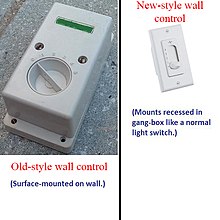
Overaged-flair choke and new-style capacitor based wall control
- Rampart-affixed control. Just about fans have their control(s) mounted happening the paries as an alternative of connected the fans themselves; these are very common with industrial and HVLS fans. Such controls are usually proprietary and/or specialized switches.
- Mechanical palisade operate. This style of switch takes varying physical forms. The wall command, which contains a motor speed governor of some sort, determines how much power is delivered to the fan and therefore how fast it spins. Older such controls employed a congest— a mountainous iron-cored coil— as their regulator; these controls were typically large, boxy, and come up-affixed on the bulwark. They had anyplace from 4 to eight speeds. Newer versions of this case of control do non use a choke as much, but much smaller capacitors and/or jelled-state circuitry; the switch is typically affixed in a standard in-wall in crowd box.
- Digital wall control. With this fashio of control, all of the fan's functions— on/off status, speed, the centering of rotation, and any attached light fixtures— are controlled by a computerised wall control, which typically does not require any extraordinary wiring. Or else, IT uses the normal house wiring to send coded electrical pulses to the devotee, which decodes and acts on them using a built-in set of electronics. This vogue of controller typically has anyplace from iii to seven speeds.
- Tune remote control. In recent years, remote controls have dropped in terms to become cost-effective for controlling ceiling fans. They whitethorn be supplied with fans or fitted to an existing sports fan. The hand-held remote transmits radio frequency Oregon infrared control signals to a receiver unit installed in the fan. However, these may not be ideal for inferior installations as the controllers need batteries. They can as wel fetch misplaced, especially in installs with many fans.
- Directional Switch. Most ceiling fans typically feature a moderate slide flip-flop on the motor organic structure of the fan itself, which controls the direction in which the fan rotates. In one position, the fan is caused to rotate dextral, in the other stead the fan is caused to rotate counter-clockwise. Apt that the winnow blades are typically slanted, this results in the air either being closed upwards operating room brought downwards. While the user can select which they favour, typically air is blown downwards in summer and lifted upward in wintertime. The down blowing is experient as "cooling" in summer, while the up convection brings ceiling-hugging warm air back down throughout the elbow room in winter.[9]
Compartmentalisation of cap fans [delete]
Ceiling fans can be classified into three main categories based on their use and functionality. Each type offers or s unique advantages over the others and therefore is suitable for a ad hoc application. These include household, industrial and large-diam fans.
- Household fans usually have 4 Beaver State 5 wooden blades, a decorative motor housing, and a acceptable three speed motor with pull-chain switching control. These fans come in two varieties, with or without a light kit, depending on the price and consumer preferences.
- Mercantile or industrial ceiling fans are typically used in stores, schools, churches, offices, factories, and warehouses. Such a fan is designed to be more efficient and energy-efficient than its menag counterpart. Industrial or commercial ceiling fans typically use trey or four blades, typically made of either steel or atomic number 13, and operate at high speed. These energy-businesslike ceiling fans are designed to push massive amounts of publicize across large, wide open spaces. From the late 1970s to the mid-1980s, metal-bladed industrial cap fans were touristy in lower berth-income American households, likely due to them being priced lower than wood-bladed models. Industrial style ceiling fans are very popular for household applications in Asia and the Middle East.

A 5-blade ceiling fan in a restaurant.
- HVLS fans are large-diam ceiling fans, motivated for large spaces much as large warehouses, hangars, shopping malls, railroad line platforms and gymnasiums. These fans generally spin at a glower accelerate just attributable their grand diam, ranging between 7' and 24' (2.1m and 7.3m), can provide a large area with a gentle zephyr. Modern HVLS fans use airfoil-style blades for optimized vent drive at a reduced vigor cost. One of the most notable manufactures of HVLS fans is Big Bottom Fans.

A High-volume throaty-speed rooter
- UL Dampish and UL Wet-rated ceiling fans, otherwise titled indoor/outdoor ceiling fans, are designed for use in partly enclosed or open out-of-door spaces. The body and blades are made of materials and finishes that are not A drastically affected aside wet, temperature swings, or humidity as time-honoured materials and finishes. Damp-rated fans are suitable for covered areas look-alike bathrooms, patios and porches that aren't directly exposed to water. In open places where the fan May come in contact with water, one must use soppy-rated fans. Fresh-rated fans have a completely sealed motor which can withstand direct exposure to rain, snow and can even be washed off with a garden hose. Both industrial and residential fans come in sober-rated too as moist and wet-rated varieties.[10]
Types of cap fans [edit]
Many styles of cap fans have been highly-developed over the years in response to several contrasting factors such as growing vigor-usance cognizance and changes in decorating styles. The coming and phylogenesis of original technologies have also played a major role in ceiling devotee development. Following is a list of major ceiling fan styles and their defining characteristics:
- Iron ceiling fans. These account for almost all ceiling fans made since their invention in 1882 through the mid-1960s. A cast-iron housing encases a very industrial motor, usually of the murky-pole variety. These motors are lubricated by way of a thrust bearing submerged in an oil-bath and must be oiled periodically, normally once Oregon twice per year. Because these fans are so sturdily well-stacked, and due to their utter lack of electronic components, it is not uncommon to see cast-smoothing iron fans aged eighty age or Sir Thomas More running strong and still in expend today.

A robust ceiling fan made past Huntsman, dating from the early 1980s. This model is called the "Original".
-
- The Hunter 'Original' (manufactured by the Hunter Fan Co.) is aside far the just about recognizable example of a cast-iron cap rooter now. It has enjoyed the longest yield unravel of any fan in history, dating from 1906 to the present day. The Hunter Original working a shaded-pole motor from its inception until 1984 (the 36" Original remained shaded pole in front it was replaced with the 42" Original in 1985), at which point it was changed to a much more efficient permanent split-capacitor motor. Though the fan's physical appearance remains virtually unchanged, the motor was downgraded in 2002 when yield was shipped to Taiwan; the motor, though nonmoving oil-lubricated, was switched to a "skeletal" invention, as discussed below, with a short main shaft that inadvertently caused reliability issues. In 2022, this efferent design was revised, and once over again employs a full-length chief shaft; the key out element to the seniority of the pre-2002 motors.
- 20 celestial pole Induction "Pancake" motor ceiling fans. These fans with highly efficient cast aluminum housings, were fictional in 1957 by Crompton-Crackling, Ltd of India and were first imported into the United States in 1973 by Encon Industries. This Crompton-Greaves motor was developed through a joint venture with Crompton-Parkinson of England and took 20 years to cold. It is considered the most energy-efficient drive ever factory-made for ceiling fans (apart from the DC centrifugal) since it consumes less push than a household candent light medulla.

The Ralph Waldo Emerson "Heat Fan", the first cap fan to role a stack motive

A confining-up of the dropped flywheel along a FASCO "Charleston" ceiling fan
- Stack-motor ceiling fans. In the late 1970s, repayable to ascending energy costs prompted aside the vigor crisis, Emerson modified their "K63" motorial, commonly used in household appliances and heavy-duty machinery, to beryllium used in cap fans. This new "stack" motor, On with Encon's cast aluminum 20 pole motor, proved to make up powerful, yet energy-efficient, and assisted in the comeback of cap fans in America, since it was far less expensive to maneuver than air conditioning. With this excogitation (which consists of a basic stator coil and rotor), the fan's blades mount to a central hub, called a flywheel. The flywheel which is made of either metal or reinforced rubber can be mounted either sluice with the fan's motor living accommodations (concealed) or prominently on a lower floor the rooter's causative housing (known as a "dropped flywheel"). Many manufacturers used and/or developed their personal stack motors, including (but not limited to) Casablanca, Emerson, FASCO, Hunter, and NuTone. Some manufacturers trademarked their personal personification of this motor: for example, Emerson's "K63" and later "K55" motors, Fanimation's "FDK-2100", and Casablanca's "XLP-2000" and "XLP-2100". The earliest stack-drive fan was the Emerson "Heat-Fan", aka the "Universal Series", a utilitarian sports fan with a born metal flywheel and blades ready-made of fibreglass and later moulded plastic depending on the model. This winnow was produced in numerous different forms from 1962 through 2005 and, while targeted at commercial settings, also launch great success in human action settings. Casablanca Fan Co. also made stack-motor fans with concealed flywheels rather than dropped flywheels. While this motor is not nearly as widely used as in the 1970s and 1980s, it nates still cost found in certain high-end Fanimation fans. One disadvantage of this type of sports fan is that the flywheel, if it is made from rubber, will dry and crack all over time and eventually fall in; this is unremarkably not dangerous, but it renders the fan inoperable until the flywheel is replaced.

A spinner rooter with light kit up

A new three sword spinner fan from India
- Direct-drive cap fans utilize a motor with a stationary inner core with a shell, made of cast iron, cast aluminium, or stamped steel, that revolves around IT (commonly called a "spinner" causative). The blades are attached directly to this shell. No-nonsense-drive motors are the least expensive motors to give rise, and tout ensemble are the most prostrate to failure and noise generation.[2] Piece the very low motors of this typewrite (for the first time used in the 1960s) were relatively heavy, the superior of these motors has dropped importantly in recent years. This typewrite of motor has become the de facto authoritative for today's fans; information technology is used in altogether Hampton Bay and Entertain Breeze through cap fans sold nowadays, and has commonly been used by most other brands.
- Spinner-motor fans, sometimes incorrectly referred to equally "spinners", employ a direct-drive (spinster) motor and do have a stationary ornamental cover (motor housing). "Spinner-causative" fans account for nearly every fans manufactured from the late 1980s to the deliver.
- Spinster fans employ a direct-parkway motor and Doctor of Osteopathy non have a stationary decorative cover (motorial living accommodations). This accounts for just about industrial-style fans (though such fans sometimes have more moderate-choice motors), and inexpensive act fans commonly found in Brasil, South Asia, Southeast Asia and many Middle Eastern countries.
- Skeletal motors, which are a last-terminate subset of direct-drive motors, give notice be found on roughly higher-quality fans. Examples of pinched motors let in Hunter's "AirMax" centrifugal, Casablanca's "XTR200" motor, and the motors ready-made by Sanyo for use in ceiling fans sold low-level the Lasko appoint, and post-2002 Hunter "Creative" ceiling fans. Skeletal motors differ from rhythmic direct-drive motors in that:
- They possess an open-border ("skeletal") design, which allows for ALIR better ventilation and consequently a longer life-time. This is in comparison to a regular direct-private road motor's aim, in which the motor's interior working are completely engulfed within a tight metal shell which may operating theater may not have openings for ventilation system; evening when openings are present, they are almost always small pertinent of being short-handed.
- These are typically big than regular direct-movement motors and, A a result, are Sir Thomas More almighty and less prone to burning out.
- Friction-repel ceiling fans. This temporary type of ceiling fan was attempted aside companies such as Emerson and NuTone in the late 1970s with weeny success. Its advantage was its hugely bass power consumption, but the fans were unreliable and very noisy, in addition to being grievously underpowered. Friction-drive ceiling fans employ a low-torque motor that is mounted transversely in copulation to the flywheel. A rubber wheel mounted on the end of the motor's shaft drove chisel a hub (via contact friction, hence the name) which, in turn, horde the flywheel. It was a system based on the fact that a low-torsion motor spinning apace butt drive a deep, heavy device at a slow speed without extraordinary Energy wasting disease (see Paraphernalia ratio).
- Gear-drive ceiling fans. These were similar to (and eve less average than) the friction drive models; however, instead of a rubber wheel along the causative shaft victimization friction to turn the flywheel, a toothed gear happening the cease of the motor shaft meshed with geared wheel teeth formed into the flywheel, gum olibanum rotating IT. The company "Republic of Panama" successful gear driven ceiling fans and oversubscribed them exclusively through the "Family Handyman" magazine in the 1980s.
- Internal belt-drive ceiling fans. These were as wel similar in design to gear mechanism-drive and friction-ride fans; however, alternatively of a no-good friction wheel or toothed paraphernalia, a small rubber belt linked the motor to the flywheel. The most notable internal smash-drive cap fans were the early models produced by the Casablanca Fan Co. and a model sold away Toastmaster.
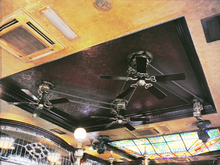
Three fans driven by a single motor and belts
- Rap-driven ceiling fans. As stated earlier therein article, the first cap fans used a H2O-powered system of belts to tour the blades of fan units (which consisted of zero more than blades decorated on a flywheel). For period-themed decor, a few companies (notably Fanimation and Woolen Mill) have created reproduction belt-drive fan systems. The reproduction systems feature an electric motor as the driving coerce, in situ of the water-powered motive.
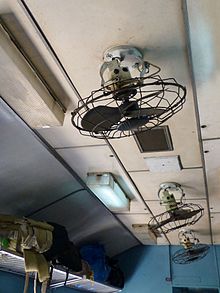
- Orbit fans apply a mechanism to oscillate 360 degrees. They are likewise typically reddened to the ceiling like hugger type fans. They are too very small in sized, usually, about 16" and have a similar construction thereto of many stand fans and desk fans, and usually feature finger guards. These are in one case again, popular for the most part in many developing countries as they are a cheap alternative to orthodox paddle type ceiling fans. Many American manufacturers, such A "Fanimation" have started producing high quality designer versions of such fans.
- Mini ceiling fans are mostly found in inferior industrial places, such as the Philippines and Indonesia, and now are constructed similarly to most oscillating pedestal and table fans, preponderantly come out of the closet of plastic. These fans, hence the name "miniskirt" ceiling fan are relatively smaller in size, usually ranging from 16 inches to 36 inches, withal, some still span to sizes as prodigious as 42 inches in diameter. In addition, unlike traditional cap fans, these fans typically use synchronous motors.
- Bladeless ceiling fans. This type was introduced in 2012 by Exhale fans and uses a bladeless turbine to push air outwards from the fan, which is also the case of regular ceiling fans on updraft mode. These fans feature a brushless DC motor instead of a normal direct-drive motor.[11]
- A pendulum fan or flutter fan is a type of low velocity ceiling fan that can be used for free-flying circulation around a targeted area. The back and onward gesture increases turbulence close to temperature reduction sources, like chilled waterfalls at the Lavin Bernick Focus on at Tulane, helping to cool a greater volume of air.
- Groomed DC ceiling fans. Before the current switched from DC to AC, there were productions of brushed DC cap fans. Those are tense directly to DC wires.
- Brushless DC ceiling fans. This type of fans uses BLDC engineering which offers much higher efficiency than formula fans driven with traditional AC motors. These are quieter than Atomic number 89 motor fans imputable the fact that they are commutated electronically and use permanent magnet rotors. Among the other advantages, these fans offer are high efficiency, lower dissonance flat, to a lesser extent rotor coil inflame, integration of remote and other convenience technologies etc. The lonesome drawbacks are the high be and the mien of complex electronics which may be more prone to failure and difficult to help. However, with the advent of new technologies and better quality ensure techniques, the latter is becoming less of a concern.[12] Those are wired to AC wires on with Ac/DC adaptor.
- Smart ceiling fans. These fans can be restrained by Google Assistant, Amazon Alexa Assistant, Apple Homekit and Wifi. A Brobdingnagian majority of these fans use BLDC motors imputable their microcontroller based design, flexibleness in fine controls and firmware upgrade capability. The speed, brightness and timing of the fans canful comprise adjusted with a smartphone app.[13]
Safety concerns with installation [edit]
A typical ceiling fan weighs between 8 and 50 pounds when fully assembled. While umteen junction boxes can support that weight while the fan is hanging still, a fan in operation exerts many additive stresses—notably torsion—on the physical object from which it is decorated; this can cause an improper junction box to fail. For this reason, in the United States the National Electric Cypher (document NFPA 70, Clause 314) states that cap fans must be supported by an electrical junction boxwood enrolled for that use. It is a common slip for homeowners to supervene upon a thin fixture with a ceiling fan without upgrading to a proper junction box.
Low-dangling fans/danger to limbs [edit]
Another concern with installing a ceiling fan relates to the to of the blades relative to the floor. Building codes throughout the United States disallow residential ceiling fans from being mounted with the blades closer than seven feet from the floor;[ quotation needed ] this sometimes proves, however, to not be high enough. If a cap fan is turned on and a person fully extends his operating theatre her arms into the air, as sometimes happens during normal tasks so much as dressing, stretching operating room changing bedsheets, information technology is possible for the blades to strike their manpower, potentially causing injury. Also, if unrivalled is carrying a recollective and bunglesome object, one end may inadvertently enter the route of rotation of a ceiling fan's blades, which can movement damage to the winnow. Building codes throughout the The States also prohibit industrial ceiling fans from being affixed with the blades closer than 10 feet from the trading floor for these reasons.
MythBusters: "Slayer Ceiling Fan" [cut]
In 2004, MythBusters tried the idea that a ceiling buff is capable of decapitation if an individual was to stick his or her neck into a running fan. Two versions of the myth were dependable, with the first being the "jumping kid", involving a tyke jumping up and down on a bed, jumping likewise advanced and entering the fan from below and the second gear being the "buff's leap", involving a husband leaping towards his bed and entering the fan side-on. Kari Byron and Scotch terrier Chapman purchased a regular household fan and also an industrial fan, which has metal blades A opposed to wood and a more powerful motor. They busted the myth in both scenarios with both house and industrialised fans, equally tests established that act ceiling fans are, apparently away design, mostly incapable of causing more than a tiddler injury, having low-torsion motors that stop quickly when blocked and blades unflappable of light materials that tend to break easily if compact at rush (the household fan test of the "lover's leap" scenario actually broke the buff blades.) They did find oneself that industrial fans, with their steel blades and higher speeds, proved adequate of causing injury and laceration - building codes require business fans to personify mounted with blades 10 feet above the floor, and the industrial fan test of the "lover's leap" scenario produced a lethal harm where the fan sliced through the jugular and into the vertebrae - but unmoving lost push rapidly once blocked and were incapable to decapitate the test dummy.[14]
Wobble [cut]
Wobbling is usually caused by the weight of fan blades being out of balance with for each one other. This can pass ascribable a variety of factors, including blades being warped, vane irons being bent, blades or leaf blade irons not being screwed on straight, or weight mutant between blades. Likewise, if totally the blades do not exert an equal strength on the air (because they have different angles, for example), the vertical reaction forces can cause wobbling. Wobble nates also be caused aside a motor flaw, but that really rarely occurs. Wobbling is not affected away the way in which the fan is mounted Oregon the mounting surface.
Contrary to popular misconception, wobbling alone will not cause a ceiling fan to fall.[15] Ceiling fans are secured past clevis pins fastened with either split pins or R-clips, indeed wobbling will not take over an effect on the fan's certificate, unless of course, the pins/clips were not secured. To date, on that point are no reports of a fan wobbling itself off the ceiling and falling. However, a severe shimmy can movement light mend dark glasses or covers to gradually loosen o'er time and potentially fall, sitting a risk of injury to anyone under the fan, and besides from whatsoever resulting broken glass. When the MythBusters were artful a fan with the goal of chopping off someone's headway, Scottie used an inch finder to find the exact center of their blades with the aim of eliminating possibly very dangerous unsteady of their steel blades.
Wobbling may live reduced by measuring the tip of each vane from a fixed point on the ceiling (or floor) and ensuring each is equal. If the fan has a metallic plate between the motor and blade, this may be mildly adjusted by bending. It can also be reduced by making sure all blades have the same pitch, and all blades have the same distance from adjacent blades. Information technology can too be reduced by having balancing weight unit on the blades.
Disposability [delete]
Ceiling fan motorial often has chemicals inside to preclude it from burning out, rendering them not throwaway. When they're placed in garbage hand truck, chemicals inside the motive can grounds pollution which is bad for human health, or in identical extraordinary cause, cause burst. It would be a better idea to recycle the cap buff, like determination a direction to deal out or donate IT. Same applies as if you leftish ceiling fans inside the building when the building is dismantled.
Heading [edit]
-
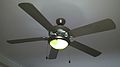
An indoor ceiling lover with dome light fixture
-

FASCO ceiling fan with tilted blades elevated towards the tip
-

Sanyo branded industrialized style ceiling fan
-

-

A dual-steel ceiling fan from India
See also [edit]
- Territory fan
- Whole-theater fan
- Windowpane fan
- Air cooler
- Fan death
- Punkah
References [edit]
- ^ "Punkah. hand-operated hanging devotee. a colonial legacy".
- ^ a b c Scharff, Henry M. Robert; Casablanca Lover Co. (1983). The Sports fan Book . Reston, VA: Reston Publishing. p. 128. ISBN0-8359-1855-6.
- ^ Dane Roger, Patricia (June 14, 2001). "Eye on Design". The Washington Post. p. H5.
- ^ Arens, Edward; Nat Turner, Stephen; Zhang, Hui (2009). "Moving Air for Consolation" (PDF). ASHRAE. Diary 51: 18–28.
- ^ Schiavon, Stefano; Melikov, Arsen K. (January 1, 2008). "Push saving and improved comfort aside increased air movement". Energy and Buildings. 40 (10): 1954–1960. doi:10.1016/j.enbuild.2008.05.001. ISSN 0378-7788.
- ^ a b Lipczynska, Aleksandra; Schiavon, Stefano; Graham, Vachel Lindsay T. (May 1, 2022). "Thermal ease and self-rumored productivity in an office with ceiling fans in the tropics". Building and Environment. 135: 202–212. doi:10.1016/j.buildenv.2018.03.013. ISSN 0360-1323.
- ^ Song, Jiafang; Meng, Xiangquan (January 1, 2022). "The Improvement of Ventilation system Contrive in School day Buildings Exploitation CFD Simulation". Procedia Engineering. The 9th International Symposium on Heating plant, Ventilation and Air conditioner (ISHVAC) joint with the 3rd Planetary Conference along Edifice Energy and Environment (COBEE), 12-15 July 2022, Tianjin, Communist China. 121: 1475–1481. doi:10.1016/j.proeng.2015.09.073. ISSN 1877-7058.
- ^ Rockwell Kent, Michael; Cheung, Toby; Li, Jiayu; Schiavon, Stefano (2020). "Experimental evaluation of visual quiver caused by ceiling fans". Edifice and Environment. 182: 107060. doi:10.1016/j.buildenv.2020.107060. S2CID 225305290.
- ^ "Ceiling fan focus". LampsUSA. Retrieved April 4, 2022.
- ^ "Indoor vs. Open-air Cap Fans: A Where to Use Guide". DelMarFans.
- ^ "How does the Exhale Fan work?". Exhale Fans Europe.
- ^ "DC vs AC Ceiling Fans". www.hunterfan.Centennial State.uk. Retrieved May 25, 2022.
- ^ S. L. A. Staff. "Best 7 Smart Ceiling Fans 2022: Google, Alexa and Wifi – smartlivingadvice.com". Retrieved September 29, 2022.
- ^ Savage, Adam; Hyneman, Jamie; Chapman, Scottish terrier; Belleci, Tory; Byron, Kari (December 5, 2004). "Ming Dynasty Astronaut". MythBusters. Season 2. Episode 24. Begins at 25:45. Find.
- ^ Gromicko, Nick. "Ceiling Fan Inspection". Planetary Association of Certified Menage Inspectors. Retrieved May 31, 2013.
External links [edit]
-
 Media related to Ceiling fans at Wikimedia Commons
How to Remove Ring From Fan Shaft Refrigerator Spring Clip
Source: https://en.wikipedia.org/wiki/Ceiling_fan

